
It is only with the heart that one can see rightly.
What is essential is invisible to the eye.
Antoine de Saint-Exupéry, The Little Prince

Since the dawn of time, stories have expanded our experience beyond the events we witness, making our lives richer and more meaningful. Their surprising turn may grab our attention, but in life we don’t like to depend on random events. Evolving to avoid chaos, our minds seek to connect events into patterns of cause and effect. We shape sequences that enable us to overcome our limited attention, to find causal relationships in an unpredictable world. Legendary French filmmaker Jean-Luc Godard understood the role of stories in how we manage life: ‘Sometimes reality can be too complex to be conveyed by spoken word. Legend remoulds it into a form that can be spread all across the world’ (in his film Alphaville, 1965). Stories share patterns of life that guide our actions. When we set out to construct believable worlds and events in our screenplay, it helps to understand how these are interpreted by our early readers, and ultimately by the film’s audiences.
Echoing Saint-Exupéry, neurologists now understand that the reduction and reconstruction of detail does not just happen in stories, but is a fundamental brain function: what you perceive to be the reality ‘out there’ is actually imagined by your brain, leaving us to experience an internal, individual ‘virtual reality representation’ that is close enough to the physical world that we don’t bump into the furniture. Neurological research suggests that only a small fraction of what we see and hear from the external world makes it through to our ‘understanding’, located in the occipital lobe of our brain. Most of that understanding comes from internal memory stores and processing modules. Our mental processes are constructions, drawing on both. Accordingly, our ‘experience’ is shaped by our expectations, seeing what we expect to see. Just like the physical blind spots in our retina don’t show up in our vision as black holes as you read this text, the brain is designed to ‘make sense’ of an incomplete understanding by ‘filling in’ the information required for us to act, to respond in a conversation and so on. The neural architecture that is used to understand movies or novels is the same process that enables us to comprehend the real world. Great storytellers have, by ‘instinct’ and ‘talent’, developed the ability to work with this active audience perception: the Oscar-winning editor of classic films as Conversation, The Godfather, Apocalypse Now, Walter Murch, defines ‘the task of the filmmaker to create gaps as wide as possible in every aspect of his storytelling, and thus making the audience the other half of the narrator’.
Throughout film history, cinematic narratives have been optimised to compel audiences into simulating fictional characters’ internal perceptions of emotions and actions. The movie unfolds not on the screen, but in your head and heart. When we watch films, we don’t just look, but we mimic the situations that display emotions. Any well designed ‘viewing experience’ goes far beyond a mere cognitive process: film researcher Torben Grodal describes it as ‘simulation in the flesh’. The writer’s task is to provide the foundation for that simulation.
It’s only a model
Psychologist Jeff Zacks even suggests that filmmakers figured out recent neurological findings much earlier through trial and error. The models that our brain constructs internally in response to sounds and images, events and characters can be understood as imagined audiovisual clips, situated in the prefrontal cortex, and these clips are the basic building blocks of our everyday conscious mental activity. These story event models are not unlike those that unfold when we picture our way home from the station, remember our parents, or strategise our response to the actions of a manipulative boss. Both imagining the future and recalling the past are executed by the same brain region – the hippocampus. Here, an imagined future or fantastic event is constructed by taking images and knowledge from the past. We navigate the future based on visual building blocks that we take from our memory, and the films we watch become part of that inventory. The same mechanism that allows us to plan a wonderful weekend and feel excited about the activities we have booked can facilitate the dread of a storm, a tearful confrontation with a loved one, or missing a flight. The experience of watching film and TV builds on, and simultaneously further develops, cognitive and emotional competencies that we use in our daily life.
Unlike language, which is based on convention, an event model emerging in our head is more like a rough image, an internal representation that takes elements from, and so corresponds to, the situation in the story. But these internal models are never a perfect record of what we have witnessed. Like the narratives as a whole, they simplify and, so, distort. The models are not designed to be ‘truthful’. Instead, they are much more useful for future use if they are incomplete and simple. This makes them adaptable for many purposes and contexts, easily combined with other components into simulations. Imperfect memories, psychologist John Seamon suggests, are an evolutionary advantage. The ‘flexibility’ of a simplified recollection helps us to draw more readily on past observations and integrate them when imagining them as part of a future plan. Bear this in mind if you find yourself forgetting your keys or a passcode in everyday life: rough, quickly adaptable memories help your own creative process. It may be a consolation to know that the lack of accurate memory is a price you pay for your creative visualisation powers. The resulting simulations are good enough for us to infer what might happen. A flawed model in real life leads to mistakes. In fiction, it can form the basis of effective slapstick, such Harold Lloyd, Laurel and Hardy and Monsieur Hulot still demonstrate on YouTube, mismatching the expectation, for example, of an action, or a fall, and the laugh-out-loud result.
Grodal sees a close connection between the ability to feel specific emotions, and to interpret the emotional content of facial expressions we see on screen. This is how filmed stories build on sharing humanity with others. It also explains how close-up shots in a film, beyond emphasising a character’s role in the story, provide the audience with a detailed facial expression that facilitates ‘emotional contagion’: to feel as the character feels. As we shape characters in our screenplays for our audience to connect with, it helps to understand the underlying neural processes.
The strength of the story-audience connection depends significantly on how well the narrative and its images are structured. A study, ‘Neurocinematics,’ by Hasson et al. explores different viewer’s experience watching a range of film clips and comparing their brain activity with MRI imaging. Hasson and his team found that viewers watching an unstructured and unedited shot of a street scene showed a wide range of different activity across a range of brain regions, suggesting a wide range of participant interpretations and experiences. But when the spaghetti western The Good, the Bad and the Ugly (1966) was screened, the brain imaging showed much more overlap in similar regions being activated across the audience. Screening a fragment from the comedy Curb Your Enthusiasm (1999-2024) revealed more overlap between activated brain regions. A clip from Hitchcock thriller Bang! You’re Dead (1961) showed the largest areas of overlap, suggesting a similar, synchronised audience experience. This leads Hasson et al to explain the effect of movies on the brain, as narrative and aesthetic mechanisms take control of viewers’ minds, and that viewers find increasing pleasure in being absorbed in this way. The practical experiment confirms film theorist David Bordwell’s idea of Hollywood’s ‘functional optimising’ of film language, to heighten audience attention: how a close-up emphasises the importance of, and supports emotional bonding with, a character; an ‘invisible cut’ during body movement hides the filmmaker’s intervention of switching one camera angle to another, and so minimises disruption; a wide shot of a building shows us where we are, a restlessly moving handheld shot through tree branches suggests a threatening observer. In this way, cinematic scenes are constructed to compel our minds into simulating the fictional characters’ emotions and actions. Psychologist Isabelle Filliozat goes on to vindicate our own reluctance to switch off screens: absorbed into the world of the story and tied to its characters through this optimised combination of performance and sound, our brain releases the neurotransmitter dopamine, putting it into a pleasant state of ‘flow’. When the screen goes dark, the dopamine levels drop, causing a pain sensation.
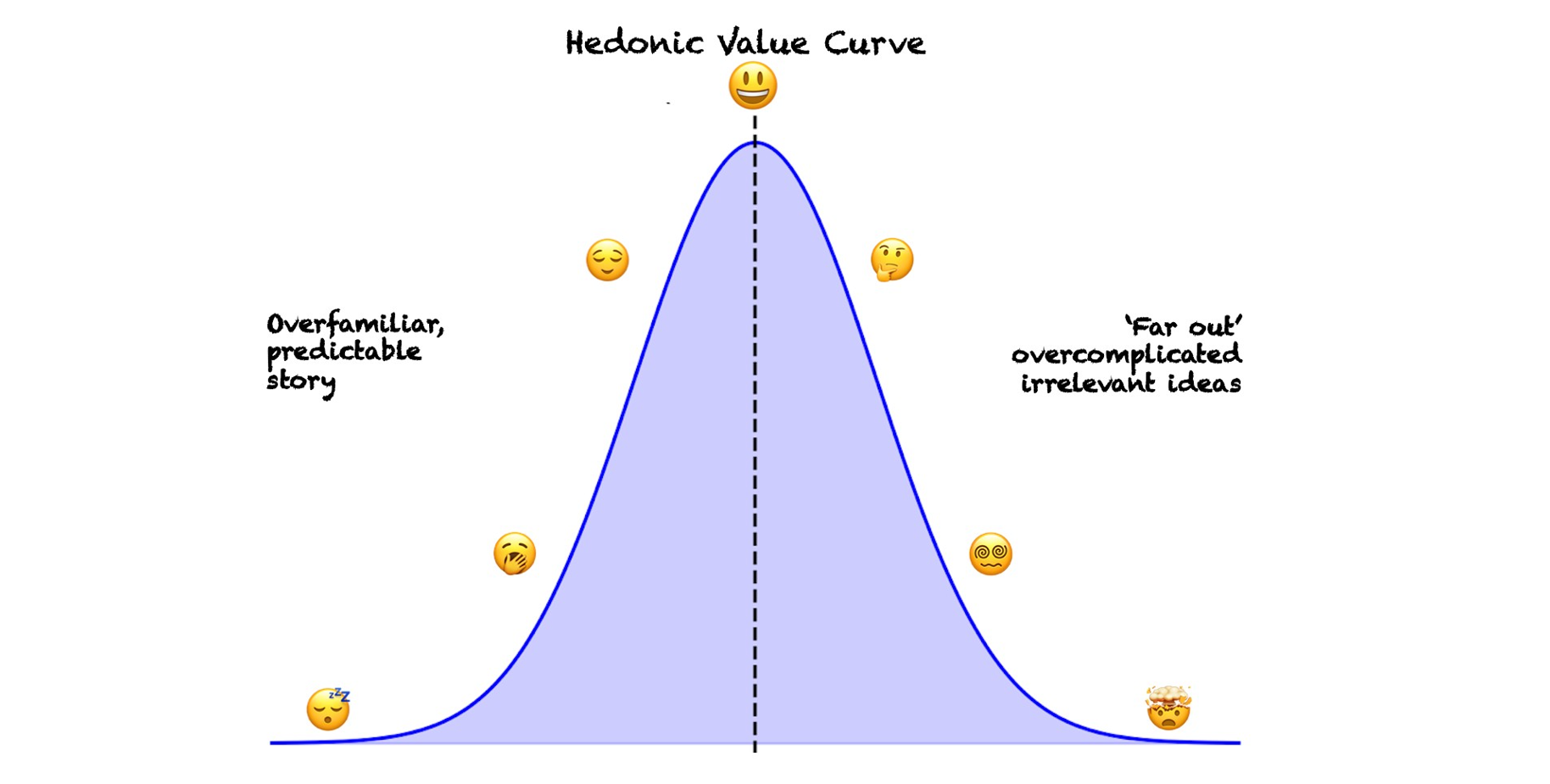
A fine balance of novelty and credibility, perhaps a dance between both attractions, is employed to build audience trust and attention. We get bored by overfamiliar, predictable, and ‘far out’, overcomplicated and irrelevant ideas, preferring a comfort zone between the lack, and a barrage, of new stimulations. This describes the hedonic value curve that tracks the excitement raised by new information, rising further as we leave the familiar behind, topping with a good surprise that feels believable and relevant to what has gone before. Just suddenly cutting to an arbitrary image with a big ‘bang’ will not create a meaningful surprise that builds excitement but leaves us with a ‘so what feeling’. With growing complexity of what is going on, the pleasure falls away until there are too many seemingly arbitrary, unrecognisable elements in the story, like a math or chemistry formula containing elements we have not learnt, thus lacking connection points to our sensemaking. It just causes cognitive overload and confusion. A ghost or spooky move of a prop may be surprising, but it may not be credible unless the ground has been prepared to allow such extraordinary phenomena. When you stand outside an endless barbed wire fence hiding a government facility, how certain are you that somewhere in there is a gateway to a secret upside-down world populated by Demogorgons, as Stranger Things (2016-2025) suggests? Do you have evidence that there is no wall to run into at London’s King’s Cross Station that, given the right lineage, will provide you with access to platform 9 ¾ and so to Harry Potter’s (2001-2011) Hogwarts? How can you make sure that the nice neighbour is not a replicant, dreading to be caught out by a Bladerunner (1982)?
The writer’s task of managing audience expectations, from the title onwards, emerges as critical for storytelling. Recognising how our expectations can lead us to misjudge what is happening is critical for any social situation, including the learning process. Through stories we evaluate events or characters, perhaps understanding that we, and society at large, may have looked at them from the wrong perspective in the past, shaped by racism, misogyny and other prejudices that have felt natural at some stage. Stories like The Wire (2002-2008), Green Book (2018), and Judas and the Black Messiah (2021) can provide important context, for example, of how racism evolves and perhaps what can be done to starve it of oxygen, to recalibrate how we look at people and their actions in the future.
Strong emotions like surprise, anxiety and disgust can be experienced together with motor reflex responses, we may lift breathe in sharply, lift our hands in defence, or hide our face in our partner’s shoulder. As Inside Out 2 (2024) illustrates, these overruling emotions overpower any other thought, to take possession of the mind. They are an evolutionary advantage: the long slim shape in our path through the woods may be a snake, or a stick; a bulky dark shape could be a tree root or a bear. By the time we find out their true nature, we may be dead. In evolution, it is more advantageous to take cover, even when we are wrong, than linger too long. So, these emotions make sure we pay full attention, to make us safe rather than sorry, as our ‘surprised’ brain stops us in our tracks, to allow bandwidth focusing on the possible threat, and let our slow cognition process the situation. Likewise, fear saves us: we know not to jump off a cliff as we feel an instinctual resistance to its edge, or to avoid an aggressive animal.
Theory of Mind in Practice
Whilst not developed for storytelling, the psychological concept Theory of Mind further explains how the emotional intelligence that enables our connection to people also explains storytelling techniques that absorb us in the fictional world. Regularly referred to as ‘putting yourself in someone else’s shoes’, ‘mind reading’, ‘a sixth sense’ or ‘folk psychology’, our speculation about other’s feelings and motives enables (not accurate, but overall, surprisingly close) predictions of their actions. Like empathy, Theory of Mind describes our intuitive assumptions about the inner lives of others, including their beliefs, desires and emotions based on our observation of their actions, responses and expressions. ‘Sympathy requires imagination’, observes the Danish film director Lars von Trier (Breaking the Waves, Melancholia, The Kingdom). We can observe ourselves doing this in everyday conversations, perhaps a negotiation, a card game, or judging an accused’s innocence in court. We expand the Theory of Mind further when projecting emotions onto animal movements and expressions we see in a zoo, or when watching animation films. Disney films like Steamboat Willie (1928), The Lion King (1994), Pixar’s Monsters Inc. (2001), Ratatouille (2007) or the Toy Story franchise (1995-2026) show how non-human characters can still evoke connection through Theory of Mind.
Psychologist Simon Baron Cohen sees Theory of Mind as fundamental for our development: getting other’s attention is one of the first lifesaving skills we learn, later growing our repertoire as we imitate grownups and fictional characters. For screenwriting, we recognise how expressions and eyelines can twist the meaning of dialogue (eyeroll, averting eye contact), how actions subvert words, leading to opposite conclusions about a character’s inner life. ‘I love you’ comes across differently if the speaker stares, looks away embarrassed, or at a different character for help. This makes eyelines particularly important in the essence of drama.
Based on clear themes established in a screenplay, experienced directors and actors can build on these using their craft with character movement, as director William Friedkin explains: ‘Fear, the essential principle of fear, has something to do with having something standing behind you. It’s generally something behind you. So, there are lots of shots in The Exorcist of somebody turning around.’ Such motivated character actions can be infectious, expressing a view of how uncertainty accelerates fear, more than any ghastly image or verbal warnings. Never overestimate the (context) knowledge of your audience, but never underestimate their (emotional) intelligence.





Comments (0)